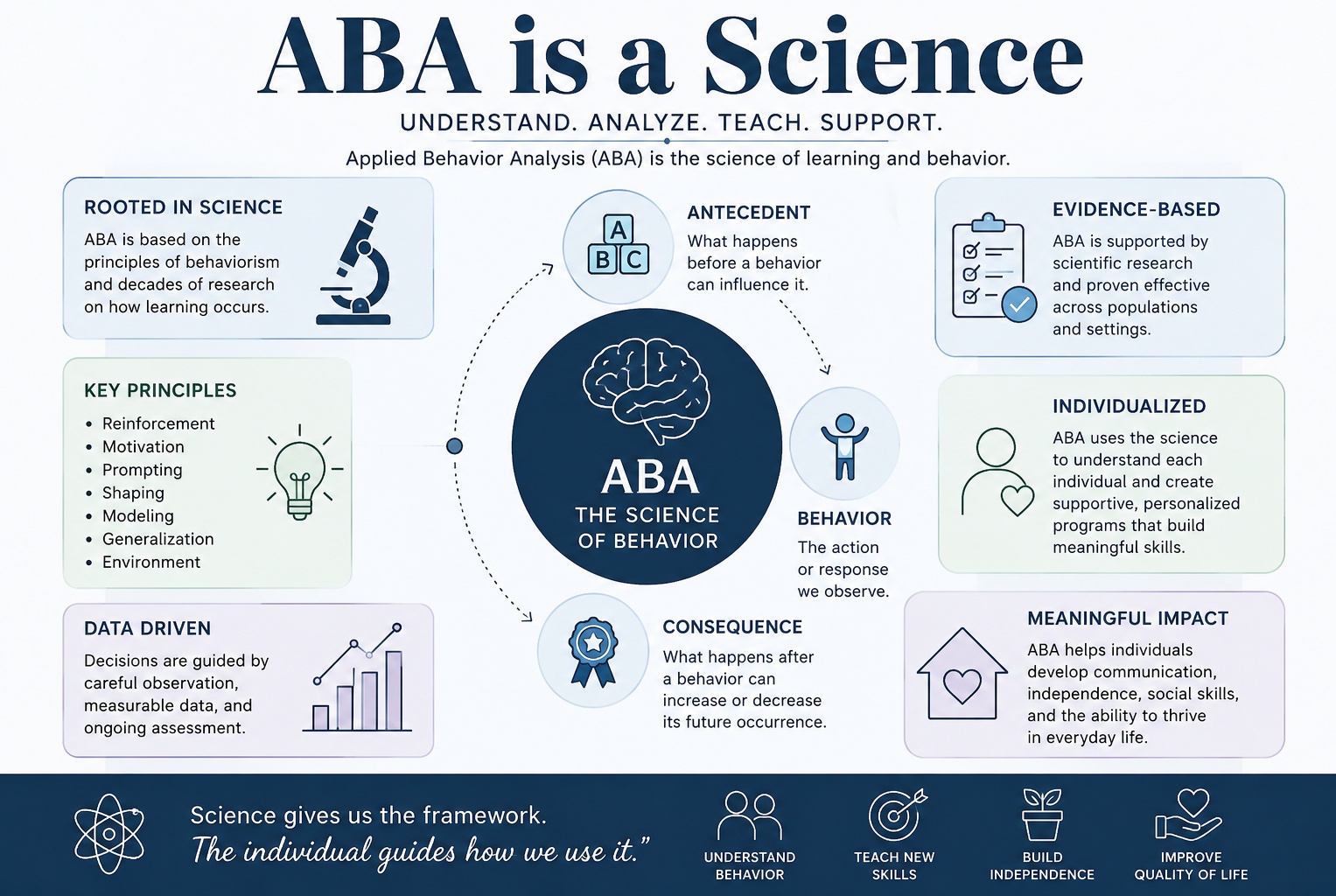
Applied Behavior Analysis (ABA) is a science focused on understanding how behavior and learning are influenced by the environment. Rooted in the principles of behaviorism and decades of research in the science of learning, ABA examines the relationship of what happens before a behavior, the behavior itself, and what happens afterward. Through careful observation and data collection, behavior analysts identify patterns and use evidence-based principles to help individuals learn meaningful skills.
From the Science of Behavior to ABA Therapy
The principles used in ABA therapy were developed through scientific research on how people learn. Concepts such as reinforcement, motivation, prompting, shaping, modeling, generalization, and environmental influences on behavior help explain why behavior occur and how new skills can be developed.
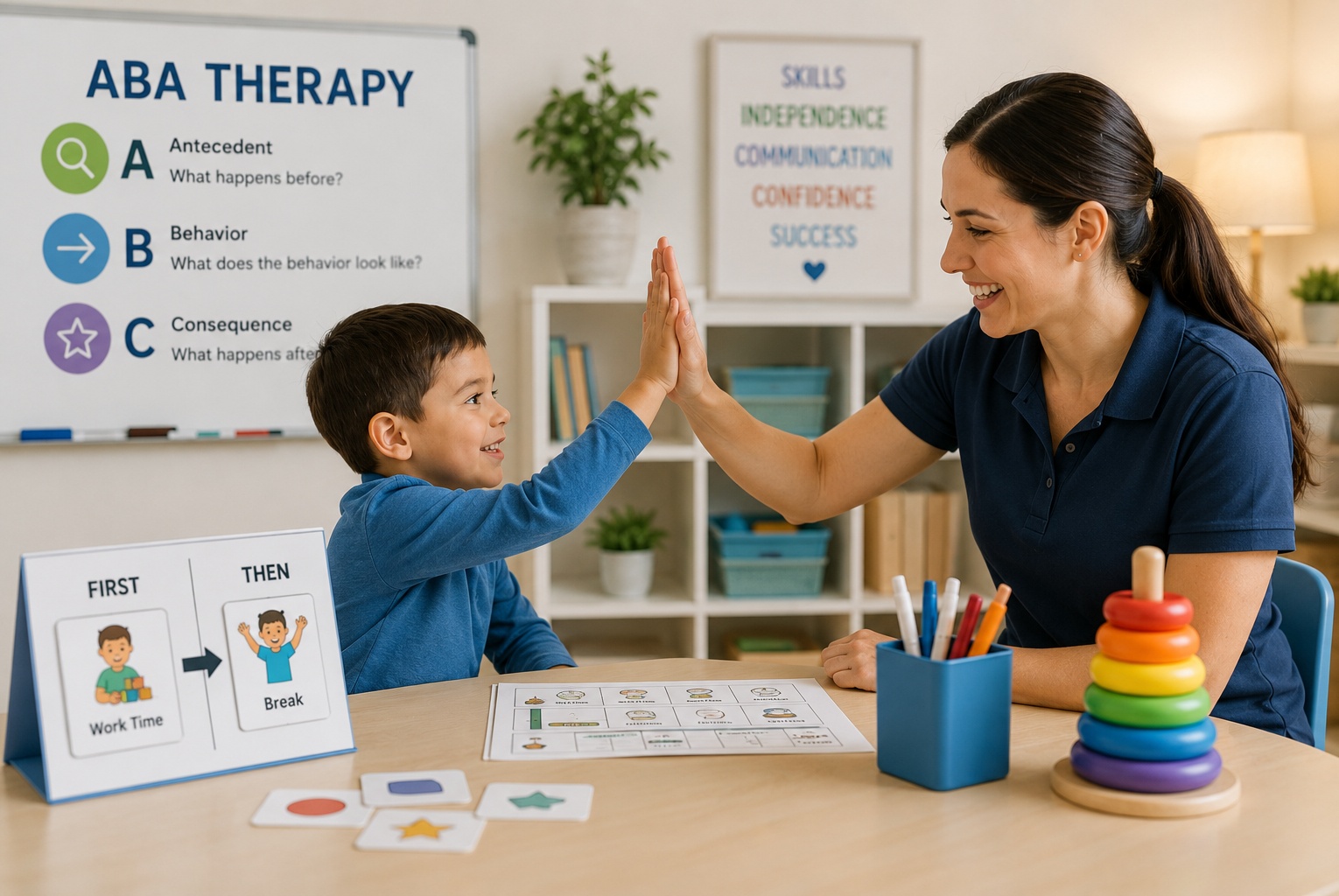
ABA therapy applies these scientific principles in practical, individualized ways. Rather than using one specific teaching method for every learner, ABA allows therapists to determine how an individual child learns best and adapt instruction accordingly.
For children with autism, ABA therapy can be used to support development across many areas, including communication, social interaction, independence, play, emotional regulation, self-advocacy, daily living skills, school readiness, and participation in everyday routines.
ABA can also help us understand behaviors that may be communicating an unmet need. Instead of simply focusing on stopping a behavior, behavior analysts look at why the behavior is occurring, what the child may be communicating, and what skills or environmental supports may help.
ABA Therapy at Behavioral Learning Solutions
At Behavioral Learning Solutions, we believe quality ABA therapy should be individualized, meaningful, compassionate, and relevant to each learner's life. We use the science of ABA as the foundation of our services while recognizing that every child has different strengths, needs, preferences, communication styles, and goals.
Our approach emphasizes naturalistic teaching, assent-based practices, communication, advocacy, independence, and individualized programming. Therapy is not simply about completing tasks or changing behaviors. We want learners to develop skills that help them communicate their needs, build relationships, participate more independently in their environments, and experience greater success in everyday life.
Teaching may occur naturally through play, conversation, social interactions, classroom activities, community experiences, and daily routines, as well as through more structured instruction when appropriate. Skills are practiced across people, settings, and situations so that learners can use what they have learned outside of therapy.
Our ABA programs may address areas such as communication, social skills, emotional and behavioral regulation, independence, adaptive skills, school readiness, executive functioning, self-advocacy, and interpersonal relationships. Goals are selected based on the individual learner rather than a predetermined program.
At Behavioral Learning Solutions, ABA is the science that guides our clinical decisions. We use its principles to understand each learner, create supportive environments, teach meaningful skills, and help children build greater independence while respecting their individuality and voice.
